
Darwin Wet Season Car Checklist: Brakes, Tyres & Battery Health
Darwin wet season brings torrential monsoons, high humidity, and standing water. Use this trade-certified checklist to inspect tyres, brakes, batteries, and wipers before the storms hit.

Dave Miller
Senior Trade-Qualified Mechanic & Workshop Lead
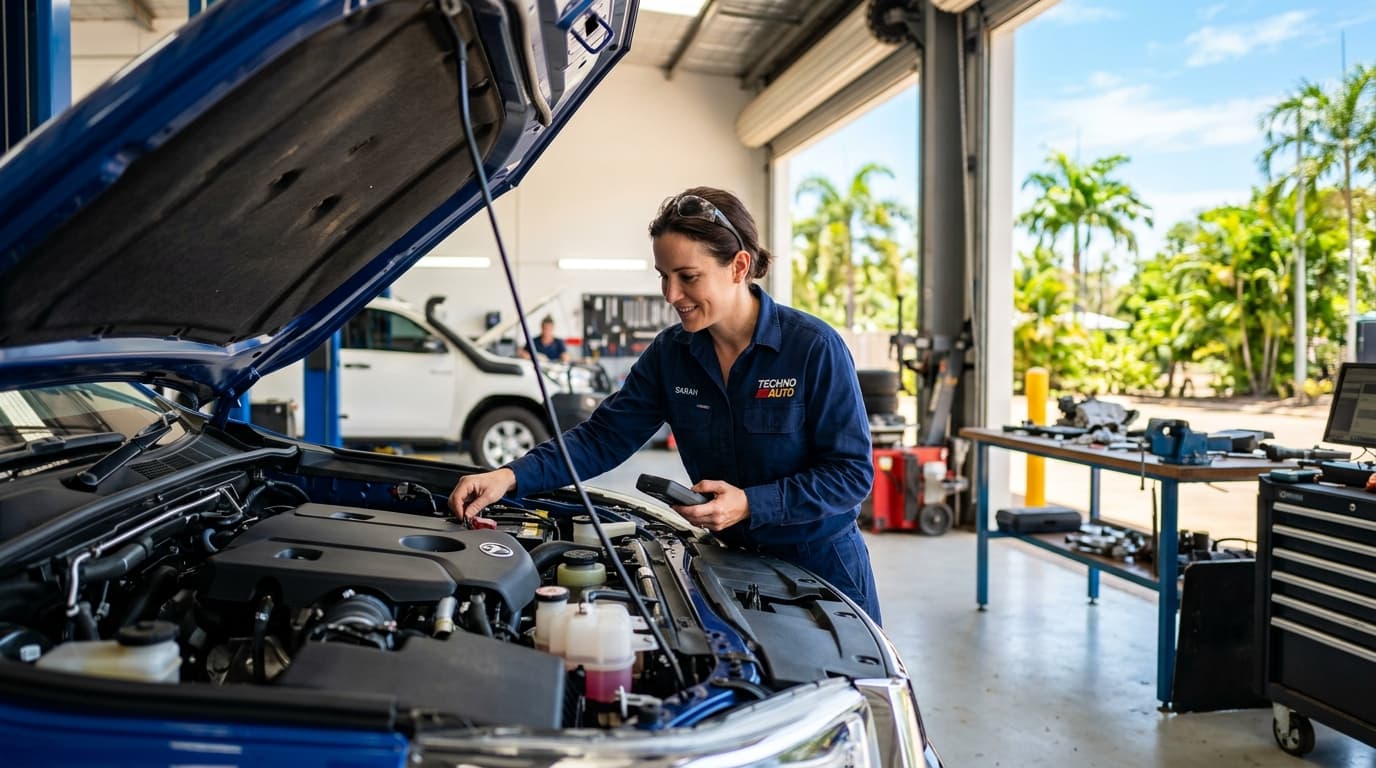
Direct Answer: Preparing your car for the Darwin wet season requires inspecting four critical safety systems before November: tyres (minimum 3.0mm to 3.5mm tread depth to prevent aquaplaning in tropical downpours), brakes (minimum 3mm pad friction material and fresh brake fluid with under 2% moisture content), battery health (conductance load test to counter 35°C+ heat-induced electrolyte evaporation), and wiper blades (silicone or heavy-duty rubber blades to ensure streak-free torrential rain clearing). Booking a pre-monsoon general car servicing in Darwin identifies worn rubber seals, alternator load issues, and suspension wear before severe monsoonal weather causes roadside breakdowns.
Darwin wet season (November through April) exposes vehicles to some of the harshest automotive environments in Australia. The combination of intense tropical humidity, 300mm+ monthly downpours, extreme ambient heat, and standing surface water on arterial roads like the Stuart Highway, Bagot Road, and Tiger Brennan Drive places immense stress on critical vehicle components.
Darwin Wet Season Vehicle Stress Index
The table below summarizes how Top End monsoonal conditions degrade vehicle safety systems and the recommended pre-season benchmark:
| Vehicle System | Monsoonal Stress Factor | Failure Symptom | Pre-Wet Season Benchmark | | :--- | :--- | :--- | :--- | | Tyres & Grip | Deep standing water, oil slick lift-off | Aquaplaning, increased stopping distance | 3.5mm+ tread depth, 34-38 PSI pressure | | Braking System | High humidity, water immersion, rust | Spongy pedal, brake fade, rotor shudder | Fluid boiling point >180°C, pads >3.5mm | | 12V Battery | 35°C ambient heat + 90% humidity | Rapid cranking failure, internal plate sulfation | Voltage >12.6V resting, load test pass | | Wiper Assemblies | Extreme dry-season UV degradation | Streaking, judder, zero torrential visibility | Fresh silicone blades, hydrophobic washer fluid | | Underbody / Chassis | Salt spray, coastal humidity, mud traps | Suspension bush rot, rust in subframe cavities | Anti-corrosion wash, grease seal inspection |
1. Tyres: Preventing Monsoonal Aquaplaning on Darwin Roads
In dry conditions, a legal tyre tread depth of 1.5mm provides acceptable traction on dry bitumen. However, on Darwin roads during sudden afternoon monsoons, 1.5mm tread depth is dangerously inadequate.
When torrential rain drops 20mm to 50mm of water in thirty minutes, water accumulates rapidly in depressions across arterial corridors. Tyres must pump up to 30 liters of water per second away from the contact patch.
- Recommended Tread Depth: While NT legal minimum is 1.5mm across the central three-quarters of the tread, safety testing shows braking distance at 80 km/h in standing water doubles once tread depth drops below 3.0mm. We advise replacing tyres once tread reaches 3.0mm before wet season begins.
- Tyre Pressure Checks: Check tyre pressure weekly when tyres are cold. Under-inflated tyres cup inward at the center, dramatically reducing water evacuation channels and triggering low-speed aquaplaning.
- Tread Pattern and Direction: Ensure directional tyres are mounted correctly according to rotation arrows. Reverse-mounted directional tyres channel standing water underneath the tyre instead of dispersing it outward.
2. Braking Systems: Moisture Contamination and Wet-Weather Stopping
Braking efficiency during tropical downpours depends directly on friction pad condition and hydraulic fluid purity:
Hygroscopic Brake Fluid Absorption
Standard glycol-based brake fluids (DOT 3 and DOT 4) are hygroscopic, meaning they actively absorb atmospheric moisture. In Darwin, where wet season relative humidity frequently hovers between 80% and 95%, brake fluid absorbs moisture through micro-pores in rubber flexible brake hoses.
- Water lowers the boiling point of brake fluid from over 230°C down to 140°C.
- Under heavy braking in traffic, boiled moisture converts into compressible steam pockets, causing total brake pedal drop and loss of stopping pressure.
- A certified brake fluid flush every 24 months is essential for Northern Territory vehicles.
Brake Pad Glazing and Rotor Corrosion
Repeated exposure to deep puddle splashes followed by rapid heat cycles causes cast iron brake rotors to develop surface oxidation. Ensure pads have at least 3mm to 4mm of friction material remaining. Inspect brake discs for deep grooving or heat spots that exacerbate wet-weather shudder.
3. Battery Health: Why Top End Batteries Fail as Wet Season Hits
Darwin drivers frequently assume car batteries fail in winter cold. In the Northern Territory, extreme ambient heat is the primary battery killer:
- Electrolyte Evaporation: Prolonged engine bay temperatures exceeding 70°C accelerate electrolyte evaporation inside lead-acid batteries.
- Internal Plate Sulfation: High heat accelerates plate corrosion, reducing Cold Cranking Amps (CCA) capacity.
- Alternator Load Spike: When the wet season arrives, your electrical system faces maximum simultaneous load: high-speed air conditioning, maximum blower fan, headlights, windscreen wipers, and demisters running simultaneously.
- Sudden Failure: A weakened battery that barely started the car during the dry season will abruptly fail during the first heavy storm when alternator load surges.
Have your mobile mechanic or service technician execute an electronic conductance load test. If your battery is older than 2.5 years in Darwin, proactive replacement with an extreme-climate, heat-resistant unit avoids inconvenient stranding.
4. Visibility and Wiper Blades: Surviving Monsoonal Downpours
Six months of intense dry-season UV rays (UV index regularly hitting 11 to 13 in Darwin) bake windscreen wiper rubber, making it brittle and cracked:
- Replace Blades in October: Replace wiper inserts or complete blade assemblies every October before monsoonal squalls arrive.
- Windscreen Washer Reservoir: Top up the reservoir with specialized anti-smear windscreen washer fluid rather than plain tap water. Monsoonal downpours lift road grime, diesel soot, and tree oils from Stuart Highway asphalt, which plain water smears across the glass.
- Cabin Air Filter: A clogged cabin pollen filter reduces demister airflow by up to 60%, causing dangerous internal windscreen fogging during humid storms.
5. Pre-Wet Season 4WD and Underbody Inspection
If you drive a dual-cab ute or 4WD around Palmerston, Howard Springs, or off-road fishing tracks:
- Differential and Gearbox Breathers: Verify that breather tubes are extended high into the engine bay or chassis rails to prevent flood water from contaminating gear lubricants during creek crossings.
- Door and Tailgate Weather Seals: Check rubber door seals for dry rot. Damaged seals permit cabin flooding during tropical downpours and water pooling in footwells.
- Suspension Bushings: Cracked rubber suspension bushings rapidly deteriorate when fine silt and mud penetrate unsealed joints during the wet.
Expert Mechanic Recommendation
"Drivers who relocate to Darwin from southern states often do not realize that wet season rain isn't ordinary shower weather. You encounter sheets of water where visibility drops to 10 meters and standing puddles are four inches deep. If your tyres are bald or your wipers are perished, you cannot safely steer or stop. A pre-wet season inspection is basic survival insurance for Top End motoring."
— Dave Miller, Senior Technician at Best Mechanic Darwin
Pre-Wet Season Checklist Summary
Before the first monsoonal squall hits Greater Darwin:
- [ ] Check all 4 tyres have at least 3.0mm tread across the full contact width.
- [ ] Inspect spare tyre pressure and ensure your jack and wheel brace are functional.
- [ ] Conduct a battery conductance load test and inspect terminals for blue-green acid corrosion.
- [ ] Fit fresh silicone wiper blades to front and rear windscreens.
- [ ] Test horn, high-beam headlights, hazard flashers, and brake lamps.
- [ ] Flush brake fluid if not replaced within the past 24 months.
- [ ] Schedule a comprehensive general car servicing in Darwin to verify cooling system hoses and fan belt tension.
Frequently Asked Questions
What is the minimum legal tyre tread depth in the Northern Territory?
The NT legal minimum tyre tread depth is 1.5mm across the original tread pattern. However, for safe driving in Darwin wet season downpours, mechanical safety authorities strongly advise maintaining at least 3.0mm to prevent dangerous aquaplaning.
How often should I replace my car battery in Darwin?
Due to extreme tropical heat and year-round high humidity, car battery lifespan in Darwin averages between 2 and 3 years, compared to 4 to 5 years in southern Australian climates.
Why do my car brakes squeal during Darwin wet season?
Brake squeal during high humidity is typically caused by surface flash rust on brake rotors or moisture film trapped between brake pads and discs. If squealing persists after a few firm braking applications, have pads inspected for excessive wear or glazed friction linings.
Does heavy rain affect vehicle electrical sensors?
Yes. Standing water splash can penetrate unsealed wheel speed sensors (ABS), oxygen sensors, or low-mounted alternators. Ensuring undertrays and splash guards are securely fastened protects critical electronic modules from water ingress.

Written by Dave Miller
Senior Trade-Qualified Mechanic & Workshop Lead
Dave has spent over 18 years diagnosing, rebuilding, and servicing vehicles across Darwin, Katherine, and rural Northern Territory. He specialises in heavy-duty 4WD drivelines, electronic fault-finding, and tropical thermal management.